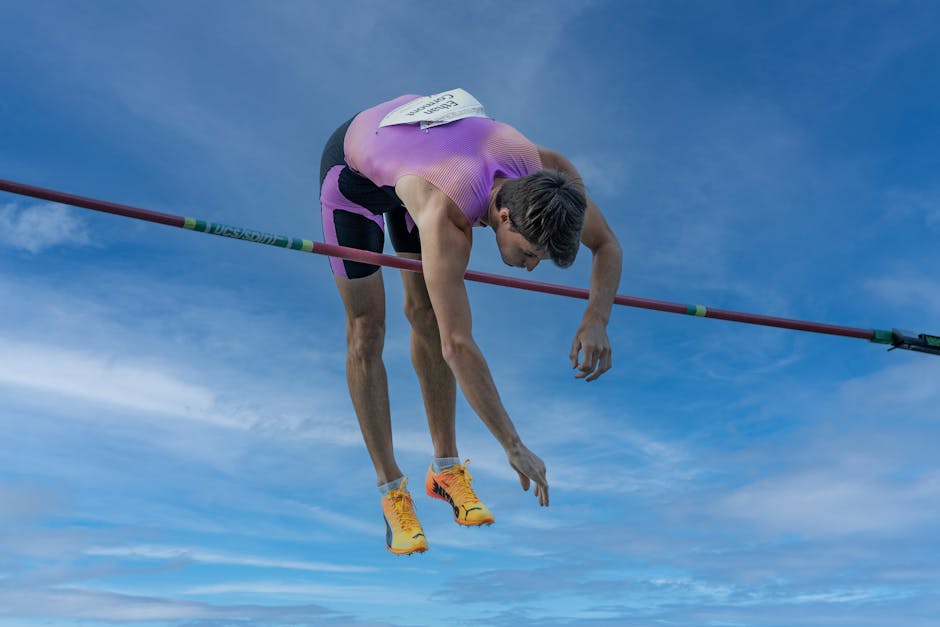
Your kid just walked in the door and announced they’re doing pole vault this spring. Your first reaction? Probably somewhere between “that sounds terrifying” and “wait, what even is pole vault?”
Take a breath — you’re in good company. Every parent of every first-year vaulter has been exactly where you are right now. Pole vault looks extreme from the bleachers, but it’s one of the most skill-based, coached, and athlete-friendly events in all of track and field. By the time your athlete takes their first real vault, they’ll have spent weeks building the technique, strength, and confidence to do it safely.
Here’s everything you actually need to know.
What Pole Vault Actually Is
Pole vault is a technical jumping event where athletes use a flexible pole to propel themselves over a crossbar as high as possible. According to World Athletics, successful execution demands speed, power, strength, agility, and gymnastic skills — all working together in a single movement that takes less than three seconds from takeoff to landing.
The vault itself has several phases coaches work through methodically with beginners: grip, approach run, plant (planting the pole in the box), takeoff, swing-up, extension, turn, and fly-away over the bar. That’s a lot of moving parts — which is why good coaching is everything at the start.
The good news: your athlete’s coach has almost certainly broken this down into a step-by-step progression. Nobody is handing a nervous freshman a 12-foot pole on day one. Progress happens in stages, usually starting on the ground with drills before working up to real vaults.
What to Expect at a Track Meet
Watching pole vault at a meet is a lot more fun once you understand how it works.
The event starts with the bar set at a beginning height. Athletes can choose to pass on lower heights and enter at a higher bar if they want — there’s strategy involved. Once an athlete decides to attempt a height, they get three attempts to clear it. Clear the bar without knocking it off and you move on to the next height. Knock it off on all three attempts at a given height, and your competition is over.
A vaulter is eliminated from competition after three consecutive failures — but those three failures don’t have to be at the same height. The winner is whoever clears the greatest height. Ties are broken by the fewest failures at the final height, then fewest failures overall.
A few spectating tips:
- Don’t yell mid-approach. Vaulters need focus on the runway — save the cheering for after the bar drops (or stays up).
- The pit looks soft and it is. Modern landing pits are large, foam-filled, and designed to absorb the fall safely.
- Every height attempt is a win. Even a miss at a new personal best is progress.
How Athletes Get Started (And Why Clubs Help)
High school coaches are great, but pole vault is a specialized event with limited practice time built into a full track program. That’s why local pole vault clubs are such a valuable resource for developing athletes.
As elite vaulter and coach Karlie Place notes on her blog, clubs exist all over the country and serve as a fantastic supplement to school programs — especially for athletes who want more repetitions and personalized coaching than a team practice allows. Many of Idaho’s best young vaulters train at club programs during the off-season and use their school season to compete.
If your athlete is serious about improving, ask their coach about local club options. The extra reps make a real difference.
The Training That Builds Vaulters
Pole vault rewards a very specific combination of athletic qualities. Here’s what the best junior vaulters are actually training:
Sprint speed is foundational. As Karlie Place explains, “the faster you are on the runway, the higher you will jump.” Your athlete’s sprint form matters just as much as their gymnastics ability. Speed translates directly to height — there’s no way around it.
Strength training during the off-season builds the muscle needed for the swing-up phase and upper body drive. This doesn’t mean bulking up — it means functional strength through pulling, pressing, and core movements.
Core work is essential for the inversion phase, where the athlete’s body goes upside-down over the bar. Without core strength, the inversion collapses. With it, athletes can extend tall and clear heights that would be otherwise impossible.
One specific drill Karlie Place highlights is the Partner Plant Drill, where a coach holds the athlete stable while they focus entirely on explosive upper-body “punch up” movement. She credits this drill with a massive personal jump in performance over a single year of training. Ask your athlete’s coach if they’re using this one.
What About Equipment — Does Your Kid Need Their Own Pole?
Short answer: maybe. Many high school programs have poles available, but as athletes progress and get matched to a specific weight-rated pole, having their own makes a real difference in consistency.
Poles are rated by the weight of the athlete — every competition-legal pole has a maximum weight limit, and vaulters must use a pole rated for their body weight or above. This is a safety standard, and it’s strictly enforced at meets.
For beginner-level athletes, TetonVault carries a range of entry-level poles from all three top brands:
- UST-ESSX Launch — a lightweight fiberglass pole built for developing vaulters, starting at $378. Forgiving bend profile, great for learning proper technique.
- Gill Pacer One — Gill’s entry-level pole with a “slowed down” bend that gives athletes more time to rotate into vertical position. Priced from $405; contact us for current availability.
- FiberSport Non-Carbon Training Poles — designed by vaulter-engineer Bruce Caldwell, these fiberglass training poles are built tough for high-rep practice environments. Available in three standard lengths from $435.
As your athlete advances, there are intermediate and advanced options across all three brands — from the ESSX Recoil, to the Gill PacerFXV and Pacer Composite, to FiberSport’s Carbon series — each matched to heavier athletes and higher grip heights.
Not sure where to start? Coach Dopp at TetonVault can help. He knows poles, knows vaulters, and knows exactly what a first-year high school athlete needs to build confidence without buying more pole than they’re ready for.
One More Thing: Enjoy the Ride
Pole vault athletes are a different breed — curious, coachable, and genuinely excited by the challenge of mastering a technical skill. If your athlete has caught the bug, you’re going to see them grow in ways that go far beyond track season.
Be patient with the learning curve. Celebrate the small wins. And when they clear a height they’ve been working toward for weeks, cheer loud — they earned it.
Ready to get your athlete set up with the right gear? Browse our full pole selection at TetonVault’s shop or reach out to Coach Dopp directly with questions about fitting your athlete to the right pole.