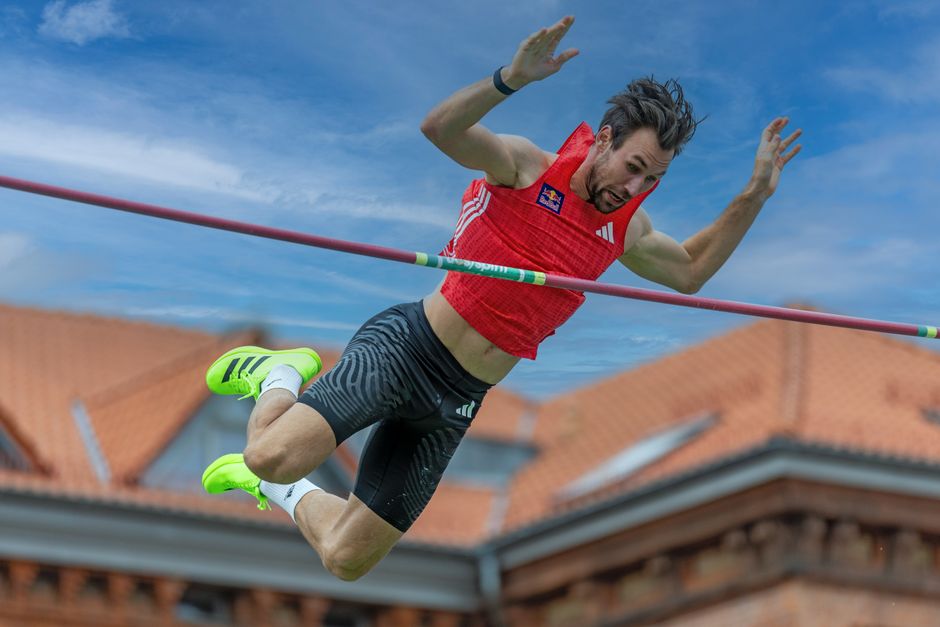
Spend enough time around a pole vault runway and you’ll hear it shouted from the side of the pit: “Get a free takeoff!” It’s one of the most common cues in the sport. But here’s a fun twist — a lot of coaches and vaulters are using that phrase to describe the wrong thing.
David Brannan of the Alaska Pole Vault Club makes a great case on Learn to Pole Vault that “free takeoff” and clean takeoff are actually two different skills, and mixing them up can send athletes chasing the wrong fix. Let’s untangle the two, look at why stepping under at takeoff isn’t automatically a jump-killer, and talk about how to train the part of the pole vault takeoff that matters most.
Clean Takeoff: Where Your Foot Is When the Pole Hits
A clean takeoff describes timing at the box: the vaulter’s takeoff foot leaves the ground before the pole tip strikes the back of the box. In a lot of coaching circles, this is also called an outside step (or “being out”).
Why do coaches love it? According to Brannan, a more outside takeoff:
- Is easier on the back and on the shoulder of the top hand
- Lets the vaulter jump up vertically and be in a taller position as the tip hits the box
The opposite is stepping under — the foot is still on the ground when the pole hits and starts to bend. Brannan points out that a slightly bent pole with the foot still down can help a vaulter vertically, but it comes at a price: a lower plant and a shorter swing.
So yes — if you can be out, be out. But a clean takeoff isn’t the whole story.
Free Takeoff: Being Free From the Pole’s Weight
Here’s where it gets interesting. Brannan defines a free takeoff as carrying and lowering the pole during the run so that the athlete can move freely and independently of the pole. In his words, a free takeoff means you’re “free” from being influenced by the weight of the pole.
When the pole isn’t free, it acts like a lever on your center of gravity, pulling you forward. That shows up as:
- Leaning forward at the end of the run
- Getting off-balance
- Striding out on the last steps as you try to launch
When you carry and lower the pole close to your center of mass, Brannan says you can accelerate more like a long jumper and launch with more upward momentum — which increases both the length and speed of your swing.
Why the Difference Matters
Here’s the key takeaway from the article: you can have one without the other.
| Clean takeoff | Free takeoff | |
|---|---|---|
| What it describes | Foot leaves the ground before the pole hits the back of the box | Athlete moves independently of the pole’s weight through the run and launch |
| Main benefit | Easier on back and top-hand shoulder; taller, more vertical jump | Better balance and speed into launch; longer, faster swing |
| Possible without the other? | Yes — you can be “out” and still get pulled around by the pole | Yes — you can be free of the pole and still step under |
Brannan notes that the current world record holder, Mondo Duplantis, consistently steps under — and it doesn’t seem to matter, because his jump is free from the pole’s influence. He describes how Duplantis sometimes drops the pole tip onto the runway in front of the box and lets it slide into place, which is thought to keep him from being pulled forward or off-center at the end of the run.
That leads to Brannan’s conclusion: having a clean takeoff is not as crucial as having a free takeoff — as long as your final step is within an acceptable range (not too far out or too far under).
Translation for vaulters: don’t panic if your coach says you were a little under. Ask a better question — was the pole pushing me around on the way in?
Why Speed and Balance Are the Whole Ballgame
Brannan backs this up with some simple physics. If you set kinetic energy equal to potential energy and solve for height, mass drops out of the equation — leaving only speed and gravity. Since gravity doesn’t change, how high you can go comes down to how fast you can run (and how little energy your technique leaks along the way).
That’s why balance on the runway is such a big deal. Your final velocity, balance, position, and launch angle as you leave the ground are everything you bring to the jump. If the pole is tipping you forward for the last few strides, you’re giving away speed you worked hard to build.
Fair warning: Brannan calls the free takeoff possibly the most difficult action to master in the vault — and it gets harder as you move to longer, heavier poles. Even Sergei Bubka, he notes, said he was only able to stay free from the pole’s influence some of the time. So if this skill takes a while to click, you’re in very good company.
How to Train a Better Takeoff
In his follow-up piece, Planting the Pole, Brannan stresses that the plant isn’t just the last step — it starts the moment you hoist the pole, and staying centered while you accelerate is critical. He also cites research finding that a large share of vaulting injuries stem from technique errors, with many of those happening during the plant/takeoff phase. Getting this right is about safety, not just height.
Here are the practice ideas he lays out:
- Count your steps. Count your takeoff foot backward down to “1, 2, 3,” then count every step so the last three match the rhythm of the plant drill (e.g., 5 – 4 – 3 – 2 – 1, 2, 3).
- The 3-step plant drill — Lift, Curl, Press:
- Lift the top hand (like pulling it out of your back pocket) to lower the tip and steer it toward the box.
- Curl the top hand toward the ear, elbow pointed out to the side.
- Press the top hand straight up as the elbow rotates forward, finishing with the bicep brushing the ear.
- Keep the bottom hand as a fulcrum. It stays close to the body and moves up, not forward. Brannan warns that pushing it forward shifts your center of gravity and often leads to leaning back, heel striking, stepping under, and losing speed.
- Land flat at takeoff. A heel strike brakes you; pushing off the forefoot can hurt your launch angle. Aim for a flat foot with the top hand fully extended above it.
- Walking + 3-step drill, then the 3-step drill into the box with rhythm.
And remember the wise words from Apex Vaulting’s “Context is Key”: the right drill depends on the athlete. For a beginner, learning to jump up and move the pole into the pit on a straight pole may matter more than anything fancy. For an advanced vaulter, short-run takeoff work on a bending pole might be the key. Don’t fall in love with a drill — fall in love with what works for your vaulter.
Takeoff Takeaways
- Clean takeoff = foot off the ground before the pole hits the back of the box. Great when you can get it.
- Free takeoff = you run and launch without the pole’s weight steering you. This is the bigger deal.
- Stepping a little under isn’t the end of the world — getting pushed around by the pole is.
- Build it with step counting, the Lift-Curl-Press plant drill, and a quiet bottom hand.
A free takeoff also starts with carrying a pole that fits you. If your pole feels like it’s dragging you down the runway, it’s worth a conversation about length and weight. TetonVault carries UST-ESSX, Gill Pacer, and FiberSport vaulting poles — browse the pole lineup, or reach out to Coach Dopp and we’ll help you find the right stick for where you are right now. See you on the runway!