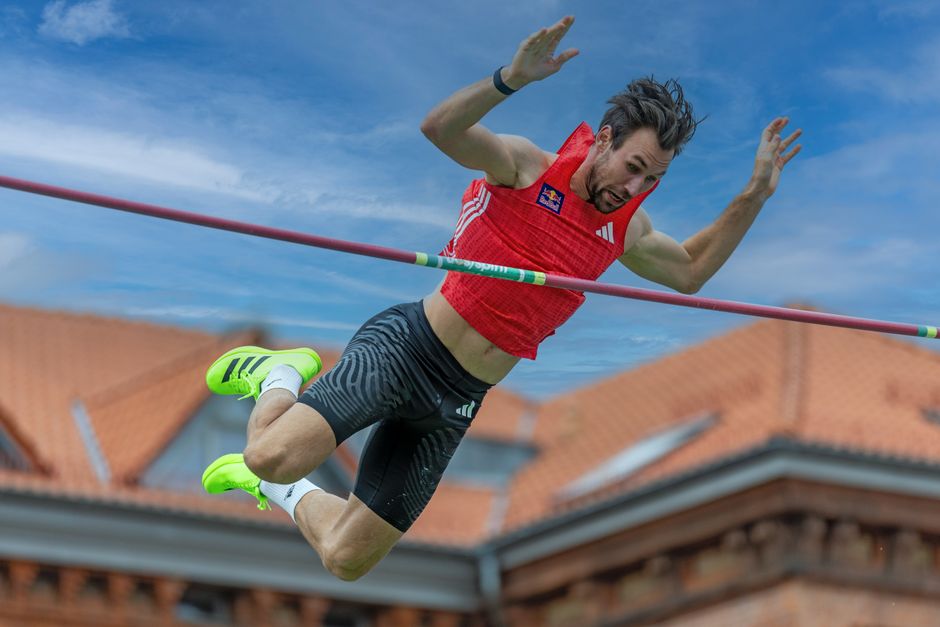
Every vaulter knows the feeling. Coach slides your hand marker up the pole, you make the jump, and you walk back down the runway feeling like a new person. Gripping up is the most visible sign of progress in the whole event — so it’s easy to assume that a higher grip automatically equals a higher PR.
Here’s the catch: it doesn’t. Apex Vaulting put it bluntly in their piece “Not All Grips Are Created Equal” — a vaulter’s grip can climb 6 to 12 inches and their PR can sit right where it was. If that sounds familiar, this post is for you. Let’s break down why grip height and push-off have to move together, what causes them to split apart, and how to track both so your grip gains actually turn into bar clearances.
Grip Is Only Half the Equation
Think of your best clearance as two numbers stacked on top of each other:
- Grip height — how high your top hand is on the pole
- Push-off — how far above that top hand you actually get your body over the bar
Grip up and keep the same push-off, and you clear more. Grip up and your push-off shrinks, and you can end up exactly where you started — or worse.
Apex shares a benchmark from Vitaly Petrov, the coach of Sergey Bubka, Yelena Isinbayeva, and Thiago Braz: for every half inch your grip goes up, your PR should go up about an inch. The idea is that a better vault doesn’t just raise the hands — it should raise the push-off too. Not everyone agrees with that exact ratio, and Apex says as much. But their bottom line is hard to argue with: when your grip goes up, your push-off should at least not go down. If it does, the “progress” is an illusion.
| What happens | Grip | Push-off | Result |
|---|---|---|---|
| Real improvement | ⬆ Up | ⬆ Up or same | New PR 🎉 |
| Trading flaws | ⬆ Up | ⬇ Down | Same PR (frustrating!) |
| Forcing it | ⬆ Up | ⬇⬇ Way down | PR gets worse |
Why Your Push-Off Disappears When You Grip Up
So what’s actually going on when the grip climbs but the bar doesn’t? Apex points to a few usual suspects:
- Delaying your swing too long. Hanging back to “survive” a higher grip can get you to the pole, but it costs you the turn and push at the top.
- Going on too soft a pole. A softer pole can make a higher grip feel manageable, but if it doesn’t unbend until you’re already past vertical, there’s nothing left to push off of.
- Trading one technical flaw for another. Maybe your takeoff improved — awesome — but now your swing is way too slow. The grip went up, the push-off went down, and the net result is zero.
That middle one is sneaky because it feels like progress. You’re bending a pole, you’re holding higher, and the vault looks bigger. The only honest judge is the crossbar.
The Swing: Where Push-Off Is Won or Lost
If push-off is the payoff, the swing is where you earn it. Learn to Pole Vault calls the swing perhaps the most technically demanding — and most misunderstood — phase of the vault. It’s the bridge between takeoff and clearance, and its mistakes are hard to see. A stalled inversion, an unfinished turn, or a bailout often trace back to a poor or mistimed swing.
Here are their key swing principles, and why each one protects your push-off when you grip up:
- Stay long and elastic. Keep the trail leg and top arm extended. Collapsing the trail leg early — often paired with pulling down on the top arm — shortens your body and kills the stretch that powers the swing.
- Lead with the chest. At takeoff, the torso drives forward while the hips trail slightly behind, preloading the core and trail leg like a stretched rubber band.
- Don’t block with the bottom arm. Locking out or stiff-arming the pole stops your chest from moving past your hands and stalls the swing. The bottom arm should guide and apply upward pressure, not fight the bend.
- Hips rise from pressure, not pulling. Use core engagement and a well-timed bottom-arm push to lift the hips. Trying to muscle them up with your arms wastes energy.
- Let inversion happen. Rotate up the pole as a continuation of the swing instead of forcing it.
Their summary nails it: the swing is where speed becomes height. When you grip up, the swing is the first thing that gets rushed or delayed — and the first place your push-off leaks away.
Track Both Numbers — Every Session
Here’s the most practical takeaway from Apex: athletes and coaches should track grip and push-off numbers so they actually know whether they’re improving. Over time, that data tells you:
- What gives you more grip
- What lets your push-off increase
- And maybe most importantly, what hurts either one
A simple vault log can be as easy as this:
| Date | Pole | Grip | Bar cleared | Notes |
|---|---|---|---|---|
| Day 1 | Length / weight | Your hand mark | Height + make/miss | Swing felt late |
| Day 2 | Length / weight | Your hand mark | Height + make/miss | Stayed long, good push |
Write it down after every jump session, and patterns show up fast. Maybe your push-off disappears every time you move to a softer pole. Maybe it drops when you’re tired at the end of practice. Either way, now you know instead of guessing.
Know When You’ve Gripped Too High
Apex gives a refreshingly simple test: if your PR doesn’t improve — or gets worse — you’re probably gripping too high. “Grip up and hope the push-off shows up” isn’t a plan. Don’t sacrifice one number for the other.
That doesn’t mean you should never chase a higher grip. It means a grip change should be earned by better technique — a cleaner takeoff, a longer, faster swing — not forced with a late swing or a pole that’s too soft for you. When the grip and the push-off rise together, the PRs follow. As Apex puts it: when you grip up, you should PR.
The Right Pole Makes This Easier
Because pole stiffness plays directly into whether you can grip up and keep your push-off, having the right pole in your progression matters. A pole that’s too soft can mask a grip problem; the right next step up lets you hold a higher grip and still get a full recoil before vertical.
TetonVault carries all three major pole lines so you can build a progression that fits your athlete — not a brand:
- UST-ESSX — Launch ($378–$409) and Recoil Advanced ($599–$1,116)
- Gill Pacer — Pacer One ($405–$570), PacerFXV ($587–$1,205) and Pacer Composite ($840–$1,440)
- FiberSport — Non-Carbon Training ($460–$545), Hybrid/Carbon ($630–$1,000), USA Carbon Plus ($675–$1,050) and the Sam Kendricks PRO ($695–$1,175)
Grip Smarter, Not Just Higher
A higher grip is exciting — but the crossbar doesn’t care where your hand is. It cares how high you get. Track your grip, track your push-off, protect your swing, and make sure every grip change earns its spot.
Not sure if you’re on the right pole for your next grip? Browse our vaulting poles or reach out to Coach Dopp — he’ll help you figure out whether it’s time to grip up, move up a pole, or clean up your swing first.