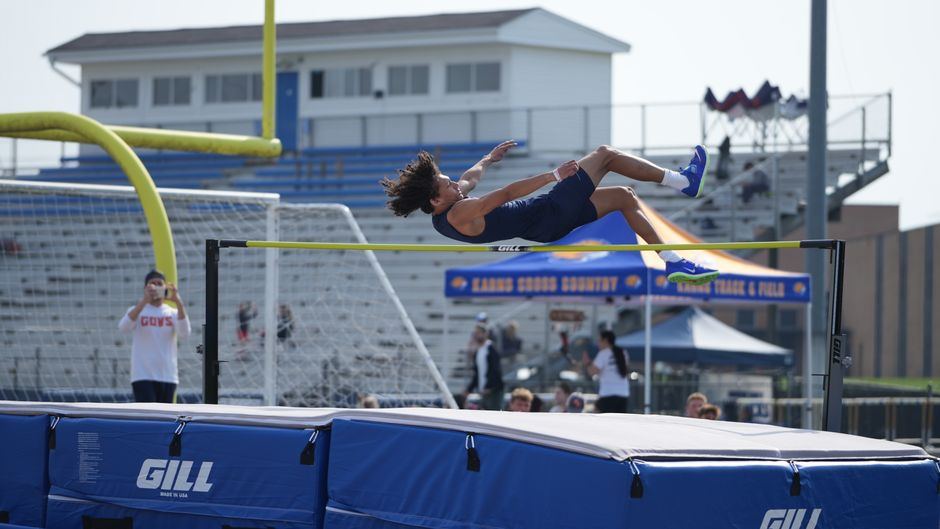
Everybody gets excited about the landing pit. It’s big, it’s expensive, and it’s the thing your athletic director sees from the parking lot. But the pit is only part of your vault facility. The vault box takes the full load of every single plant, the box collar pads the one hard spot left near the pit, and the standards hold the bar where your vaulter can actually clear it.
If you’ve already read our guide to choosing a pole vault pit, this is the other half. Let’s walk through the hardware at the end of the runway: what the rules say, what your options are, and where your money does the most good.
The Vault Box: Where Every Jump Starts (and Lands Its Load)
Your athlete runs 100-plus feet at full speed and drives the pole into a metal trough in the ground. That trough gets hit again and again, every practice, every meet, for years. So the question isn’t whether you need a good box. It’s how long you want it to last.
Gill Athletics builds its vault boxes in four materials. Here’s how they compare, with prices from our shop:
| Box | Construction (per Gill) | Rules Listed by Gill | TetonVault Price |
|---|---|---|---|
| Steel | Twelve-gauge steel, fold-and-weld, flanged edges and flared sides for a secure install | NFHS, NCAA, World Athletics | $541 |
| Aluminum | Welded aluminum, white powder coat, reinforced backstop | NFHS, NCAA, World Athletics (WA certified) | $664 |
| Stainless Steel | Stainless alloy fold-and-weld, built for corrosion resistance | NFHS, NCAA | $925 |
| Cast Aluminum | 100% cast aluminum, 3/8” wall thickness, rounded inside corners | High school, NCAA (WA certified) | $1,245 |
A few details are worth knowing before you order:
- Lids matter. Gill’s aluminum lid comes in recessed or flush designs, and the recessed version is made to accommodate a 1/2” (12mm) track surface. Gill reinforces its lids with angled vertical supports to prevent sagging, because nobody wants a lid that dips when a sprinter runs over it.
- Cast aluminum is the “buy it once” option. Gill says the rounded inside corners allow unhindered pole rotation, and the box is guaranteed against cracking or warping.
- Installation is a real consideration. Gill makes a leg installation kit with four L-shaped steel legs that let you adjust the box for more precise leveling during install. It’s listed as compatible with Gill’s 500, 502 and 504 boxes.
Coach’s take: Steel is the budget pick and works fine for a practice runway. If you’re in a wet climate or you host meets, the corrosion-resistant and cast options earn their price over a long service life.
The Box Collar: The Cheapest Safety Upgrade on Your Runway
Here’s the part a lot of programs skip, and it’s the part the rulebook doesn’t let you skip.
The edge around the vault box is one of the few truly hard surfaces left in a modern vault setup, and it sits right where a bailed jump can put an athlete. That’s why the NFHS acted on it. In its 2014 track and field rules changes, the NFHS adopted Rule 7-5-24, requiring planting box padding that meets the ASTM specification standard by the start of the 2014-15 track season. The rationale was to minimize the risk of injury to pole vaulters.
So if your collar is a hand-me-down pad of unknown origin, it’s worth checking whether it actually meets the spec.
The Gill SafetyMax+ Vault Box Collar ($874) is built for exactly this. According to Gill, it:
- Complies with ASTM standard F2949
- Meets current NCAA and NFHS rules
- Works with any style of landing system, so it doesn’t have to be a Gill pit
- Has a spike plate to reduce the collar slipping
We call it the cheapest safety upgrade on the runway, and we mean it. Compared to a landing system that runs into five figures, a compliant collar is a small line item protecting the hardest spot your vaulters can land on.
Vault Standards: Holding the Bar Right Where It Needs to Be
The standards are what actually set the challenge. They hold the crossbar at height and at the right depth over the box. A wobbly or badly anchored standard makes a mess of your meet.
Gill’s standards range from practical high school units to full championship hardware:
| Standard | Key Specs (per Gill) | TetonVault Price |
|---|---|---|
| Essentials | Full steel tubing; 6’ to 16’ height adjustment; reads English and metric; upright detaches from base for storage; wide-stance base; 75mm bar rest pins and 8 base anchors included; set of 2; meets NFHS spec; 5-year warranty | $1,460 |
| AGX M2 | Championship-level unit for meet hosts | $21,795 |
| AGX M4 | Dual hand crank height changes; 6’6” to 21’ range; crossbar depth adjustment 0cm to 80cm; 2” safety pad; Practice and Competition locking modes; meets NFHS and NCAA, World Athletics certified; 10-year warranty | $32,195 |
For most high school and club programs, the Essentials standards are the sweet spot. That 6’-to-16’ range covers middle school beginners through strong high school vaulters, and the detachable upright means they don’t have to live outside all winter.
The AGX units are built for hosts running big invitationals and championships. The hand cranks and locking modes are about keeping a big meet moving quickly. If you’re not hosting at that level, you probably don’t need to spend that much.
Don’t Forget the Anchors
This one’s easy to overlook. Standards have to stay put, and Gill’s Pole Vault Standard Anchors ($120, set of 8) are concrete anchors made to secure its standard bases. Gill’s product page lists them as meeting NFHS rule 7-4-11.
If your standards shift a little between jumps, fix that before the season starts. Nobody wants a bar-placement argument at the district meet.
Where to Spend First: A Quick Priority List
Building or upgrading on a budget? Here’s how we’d sequence it:
- Compliant box collar. It’s rule-required padding and it protects athletes. If yours is questionable, start here.
- A sound, level vault box. A cracked, sagging or badly leveled box affects every plant. Replace it before it gets worse.
- Anchored standards with the height range your athletes need. Essentials-class standards cover most high school programs.
- Weather protection. Gill’s pit weather covers run $1,855 to $3,395 in our shop and are sized to each specific landing system, so order by pit model.
- Championship upgrades like AGX standards, but only if you host meets that need them.
And remember that the facility is only half the program. Your athletes still need the right poles. We carry UST-ESSX, Gill Pacer and FiberSport poles so we can fit each vaulter to what works for them, not to whatever brand we happen to push.
Let’s Spec Your Runway
Facility hardware ships freight and a lot depends on your specific runway, climate and meet schedule, so the best way to start is a conversation. Tell Coach Dopp what you’ve got, what’s worn out, and what you’re hoping to host, and we’ll put together a plan that fits your budget and passes inspection.
👉 Browse vault boxes, collars and standards in the shop or contact Coach Dopp for a quote delivered to your track. Need poles too? Check out our pole lineup.