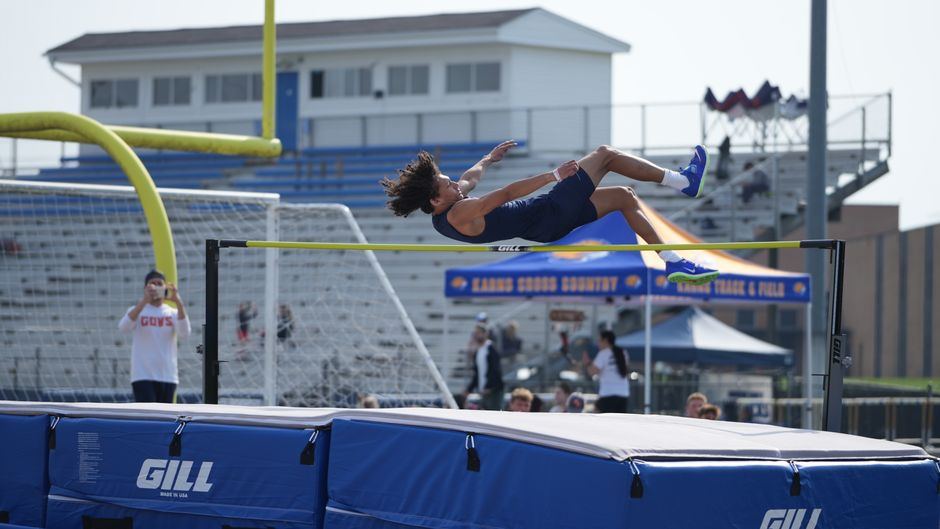
Your vault pit is probably the single most expensive thing your program owns. So here’s a fun question: what happens to it from the last meet in May to the first practice in March?
If the answer is “it sits outside and takes whatever the weather throws at it,” this post is for you. Protecting a pit is one of the least glamorous equipment jobs in track and field, and one of the smartest. Let’s walk through the three main ways to do it: weather covers, platforms, and pit garages, and where each one fits.
Why Pit Protection Is Worth Thinking About
A landing system is a big investment. Gill’s pole vault landing systems in our shop run from $16,820 to $40,995, depending on the model, and they ship freight. That’s real money for a school or club.
The good news: these pits are built to last. Gill lists a 12-year warranty on its S and G series pits and a 5-year warranty on the Essentials system. Their top pads use a heavy-duty casing and durable foam designed to stand up to repeated use.
But a warranty is a safety net, not a maintenance plan. How long a pit actually performs depends a lot on how you treat it between meets. Sitting in standing water or open weather is the kind of thing a good storage plan avoids. Simply put, the best repair is the one you never have to make.
Option 1: Weather Covers (Start Here)
A weather cover is the simplest and cheapest protection you can buy. Here’s what you need to know:
- Covers are sized to a specific pit. Gill makes a separate cover for each landing system: Essentials, S1, S4, G1, G4, G6 and AGX M4, plus “double front” covers for some G-series pits. They are not interchangeable, so know your exact pit model before ordering.
- Check the color. The Essentials cover, for example, is listed as available in royal blue only.
- Budget: Gill pole vault weather covers in our shop range from $1,855 to $3,395 depending on the pit. That works out to roughly ten percent of what the pit itself costs.
That last point is the whole argument. Ten cents on the dollar to shield the pit is easily the best return in your equipment budget.
Quick habits that make a cover work harder:
- Cover the pit every time practice ends, not just when rain is in the forecast.
- Make it somebody’s job (a captain, a rotating pair of athletes) so it doesn’t depend on the coach remembering.
- Keep tie-downs and fasteners in good shape so a windy afternoon doesn’t turn the cover into a kite.
Option 2: Platforms (Get the Pit Off the Ground)
Water doesn’t only come from above. A pit sitting directly on wet ground has its own problems.
Gill’s landing system platforms are built to support pole vault and high jump pits above the ground and prevent water damage. There are two types:
| Platform | What Gill says it does |
|---|---|
| Aluminum | Corrosion-resistant aluminum, made of individual pallets that are easy to carry and store |
| Polymer | Corrosion-resistant rubber that reduces the tendency of the pit to migrate during use, in easy-to-carry pieces |
Platforms are a great fit if your pit lives on grass, dirt or a spot that drains slowly. Pricing depends on your pit and configuration, so contact us and we’ll get you a quote.
Option 3: Pit Garages (The Full-Protection Play)
If you want to go all the way, a pit garage is a movable shelter for your landing system. Gill describes it as protection from the elements that keeps rain, snow and vandals away, and says it moves on and off position with the help of a few people. It comes in six colors: royal blue, red, white, gray, black and dark green.
There are a few things to plan for:
- A 35’ x 35’ flat build site
- A 30’ wide pathway from the build site to the landing area to the storage area, flat and clear of obstacles
- If you’re in a spot where ground snow loads are greater than 30 lb/sq ft, Gill highly recommends a Snow Load Kit
Idaho coaches, take note of that last one. Check your local snow load before you commit.
A pit garage is a bigger project than a cover, so it’s usually a second step for programs that host meets or want the maximum protection. Tell us about your site and we’ll help you figure out whether it’s worth it.
Don’t Forget the Small Stuff
A few extras help the whole setup work better:
- Pit Stop: Gill’s Pit Stop is made of 1/4” powder-coated steel plates with 1/2” spikes on the base that keep the plate from shifting. The pole vault version includes two base plates with a connector panel. It’s compatible with any pole vault or high jump pit.
- Standard anchors: Our set of 8 Gill standard anchors ($120) locks the vault standards to the runway so they stay put through a competition.
- Your poles: A protected pit is only half the story. Keep your rack in good shape too, whether it’s UST-ESSX, Gill Pacer or FiberSport. Check out our pole care and maintenance guide.
Still deciding on a pit in the first place? Start with our guide to choosing a pole vault pit.
The Bottom Line
You don’t need a fancy setup to protect your pit. Start with a properly sized weather cover and a cover-it-every-day habit. Add a platform if your pit sits on wet ground, and consider a pit garage if you want maximum protection and have the space.
Not sure which cover fits your pit, or what to add first? Get in touch with Coach Dopp and we’ll walk through it together, or browse everything in the shop for facility gear.